


Friday, June 1, 2012
Comme un boomerang
Don't forget to visit the K-1 class blog for more amazing articles! (http://gscpefdm.blogspot.com/)
Le boomerang est à l'origine une arme de chasse des Aborigènes, les natifs d'Australie. Ils s'en servent également comme d'un instrument de musique, mais aujourd'hui, tout le monde connaît le boomerang comme un jeu de lancer.Boomerangs are originally a hunting weapon of the Aborigine, the native people of Australia. They also use it as a musical instrument, but today everyone knows the boomerang as a throwing game.

We painted our boomerangs before decorating them, with shapes and animal drawings present in the Aborigine art because they are found in the bush, which is the name of the savannah in Australia and New Zealand, or in the ocean.


Tout le monde s'est bien appliqué car ce travail était très minutieux! Everyone took great care and did detailed work!


Les croix méxicaines de CE1 / CE2


Mexican cross, Peruvian or Cran Chaco cross...
Decorative or magic according to traditions, with its vivid colors and
symmetric forms, the Mexican cross brings to mind Native American art. Children of the 2nd and 3rd grade class had to
find two strait sticks on the playground and learn a technique of weaving the
wool yarn around the cross.
La motricité en maternelle


On s'amuse bien à la garderie!


Everyday, between 3:30PM and 5:30PM, children of all grades
meet in afterschool care. They start with a little snack and then take
advantage of their time in “garderie”
to run, play, talk, draw, and do their homework…
It is a good time for the students to share games with friends of their class
or with children of different age groups. According to the weather, aftercare is offered inside or outside on the playground.
Outside, the older children organize sports competitions for
the younger ones, pull sleds, children play ball, play with trucks, build forts or
fairy houses…
Inside, children make dinner in the play kitchen, play with
cars, Legos, prepare meals out of play-doh, do puzzles, do collages and
drawings, create puppet shows and they even dance sometimes!
This is so much fun that when mom and dad arrive, the children
find it difficult to leave, they want to stay just a little bit longer or they
go hide in hopes to stay at school all night!
Many thanks go to Philomene who has been running the garderie this year to the great pleasure of the children and parents!
Many thanks go to Philomene who has been running the garderie this year to the great pleasure of the children and parents!
Les jardins japonais
In art class CE1/CE2 students (grades 2-3)
were introduced to the notion of a Japanese garden. First we have talked
about its components and then we went outside to build our Japanese gardens.
The available material consisted of rocks found during our outing at the Topsham
quarry, sticks, branches, flowers, pine cones found in abundance in the woods,
sand, water and plastic bags to build a pond. Here are the pictures of our
marvelous creations:


Le B2i: Brevet informatique et internet
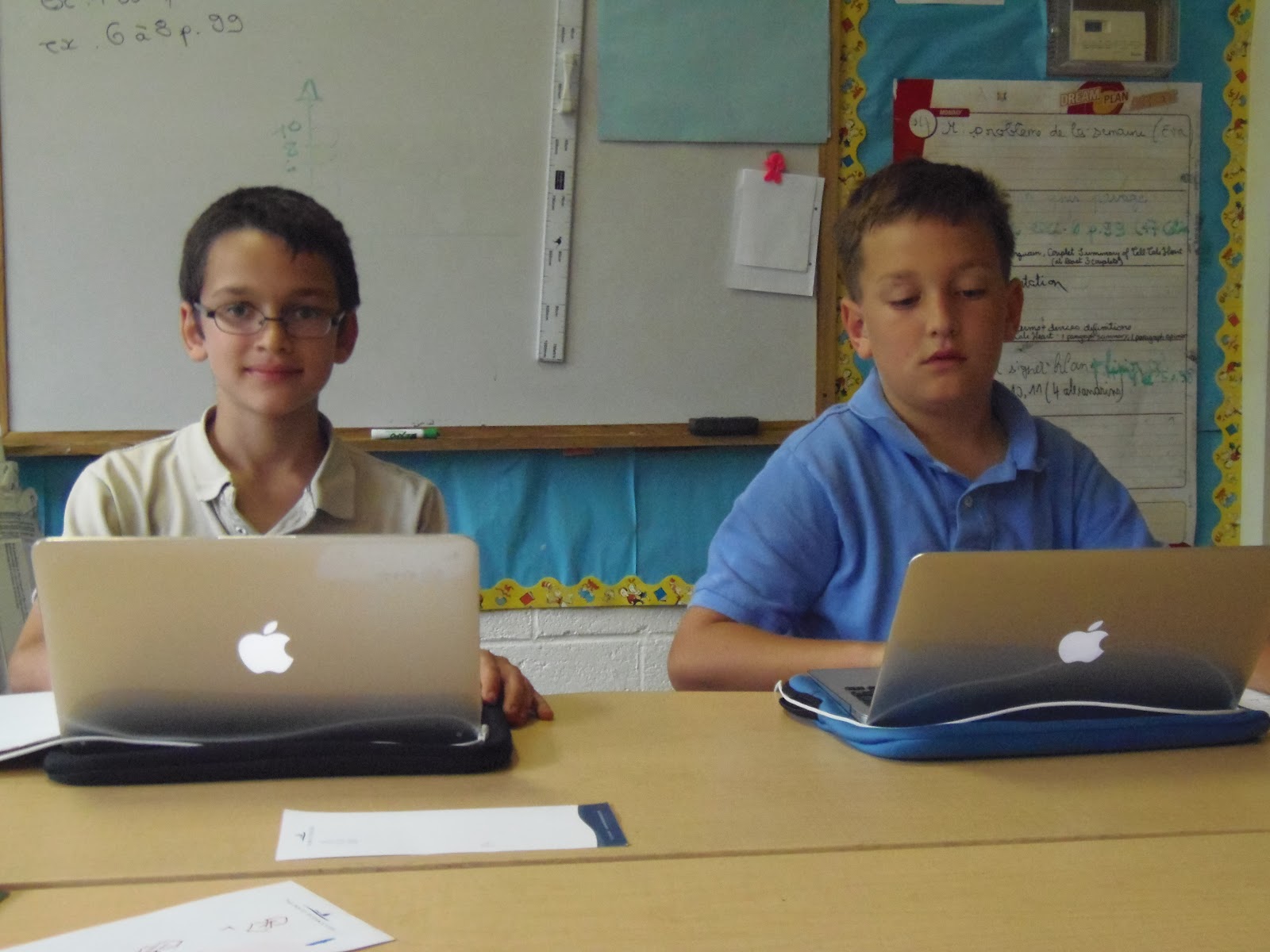

In Technology Class, the 5th Graders are currently working hard in order
to fulfill the requirements of the B2i école. In accordance with the French
Curriculum, each student must demonstrate basic knowledge of the Internet and
the use of the computer by the end of 5th grade. The competencies
are tested independently. They include typing skills, effective internet
researching, and critical use of the internet . The students will receive diplomas upon completion.
Thursday, May 31, 2012
Geckos aborigènes
Don't forget to visit the K-1 class blog for more amazing articles! (http://gscpefdm.blogspot.com/)
L'art est très important dans la culture aborigène, lié à la terre et célébrant le "Temps du rêve", qui explique l'origine du monde et de l'Australie.Il y a la musique, le mime, les costumes, la peinture, la sculpture...
Les éléments naturels sont beaucoup utilisés comme support de décor: écorce de bois, parois des grottes, sol, cailloux, coquillages... On y trouve souvent des représentations d'animaux comme le gecko, le serpent, le kangourou...
Art is very important to the Aborigine culture, linked to the earth and celebrating "The Time for dreams", which explains the origins of the world and Australia.
There is music, mime, costumes, painting, sculpture...
Natural elements are used a lot as support for decoration: bark, cave walls, ground, rocks, seashells... One often finds animal representations such as gecko, snake, kangaroo...
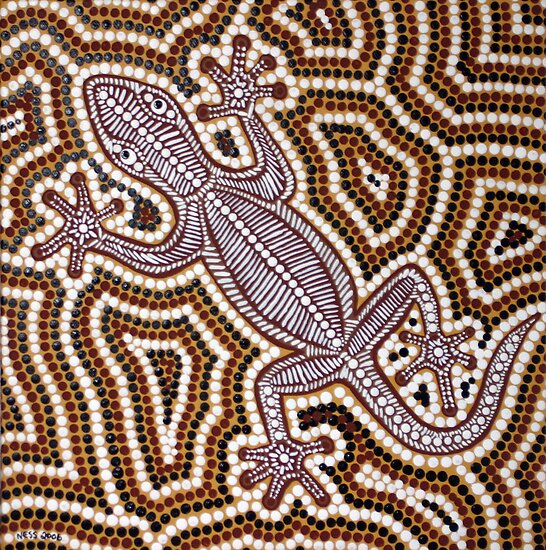
After reading a story about the origins and listening to the astonishing music of the didgeridoo, we painted and decorated big pebbles and seashells.

We used natural colors of paint they find in nature, such as ochre, green, red, brown because the aborigines used colored materials to decorate their creations: fruits, stones, dirt, leaves...


We then painted geckos on our stones or seashells, and decorated everything with little dots of different colors.


It was very interesting to paint on those new supports we find in nature!
Tuesday, May 29, 2012
The linguistic genius of babies

At TEDxRainier, Patricia Kuhl shares
astonishing findings about how babies learn one language over another
-- by listening to the humans around them and "taking statistics" on the
sounds they need to know. Clever lab experiments (and brain scans) show
how 6-month-old babies use sophisticated reasoning to understand their
world.
Patricia Kuhl studies how we learn language as babies, looking at the ways our brains form around language acquisition.

Dr. Patricia K. Kuhl is the Bezos Family Foundation Endowed Chair for
Early Childhood Learning, Co-Director of the UW Institute for Learning
& Brain Sciences, Director of the NSF-funded Science of Learning
Center, and Professor of Speech and Hearing Sciences. She is
internationally recognized for her research on early language and brain
development, and studies that show how young children learn. Dr. Kuhl's
work has played a major role in demonstrating how early exposure to
language alters the brain. It has implications for critical periods in
development, for bilingual education and reading readiness, for
developmental disabilities involving language, and for research on
computer understanding of speech.
Dr. Kuhl is a member of the National Academy of Sciences, the Rodin
Academy, and the Norwegian Academy of Science and Letters. She was
awarded the Silver Medal of the Acoustical Society of America in 1997,
and in 2005, the Kenneth Craik Research Award from Cambridge University.
She received the University of Washington's Faculty Lectureship Award
in 1998, and in the 2007, Dr. Kuhl was awarded the University of
Minnesota's Outstanding Achievement Award. Dr. Kuhl is a Fellow of the
American Association for the Advancement of Science, the Acoustical
Society of America, the Cognitive Science Society and the American
Psychological Society. In 2008 Dr. Kuhl was awarded the Gold Medal from
Acoustical Society of America for her work on learning and the brain. In
2011 in Paris, she was awarded the IPSEN Fondation’s Jean-Louis
Signoret Neuropsychology Prize.
Dr. Kuhl was one of six scientists invited to the White House in 1997
to make a presentation at President and Mrs. Clinton's Conference on
"Early Learning and the Brain." In 2001, she was invited to make a
presentation at President and Mrs. Bush's White House Summit on "Early
Cognitive Development: Ready to Read, Ready to Learn." In 2000, she
co-authored The Scientist in the Crib: Minds, Brains, and How Children
Learn (Morrow Press).
Dr. Kuhl's work has been widely covered by the media. She has appeared
in the Discovery television series "The Baby Human"; the NOVA series
"The Mind"; the "The Power of Ideas" on PBS; and "The Secret Life of the
Brain," also on PBS. She has discussed her research findings on early
learning and the brain at NBC's Education Nation, and on The Today Show,
Good Morning America, CBS Evening News, NBC Nightly News, NHK, CNN, and
in The New York Times, Time, and Newsweek.
Subscribe to:
Posts (Atom)