Friday, March 23, 2012

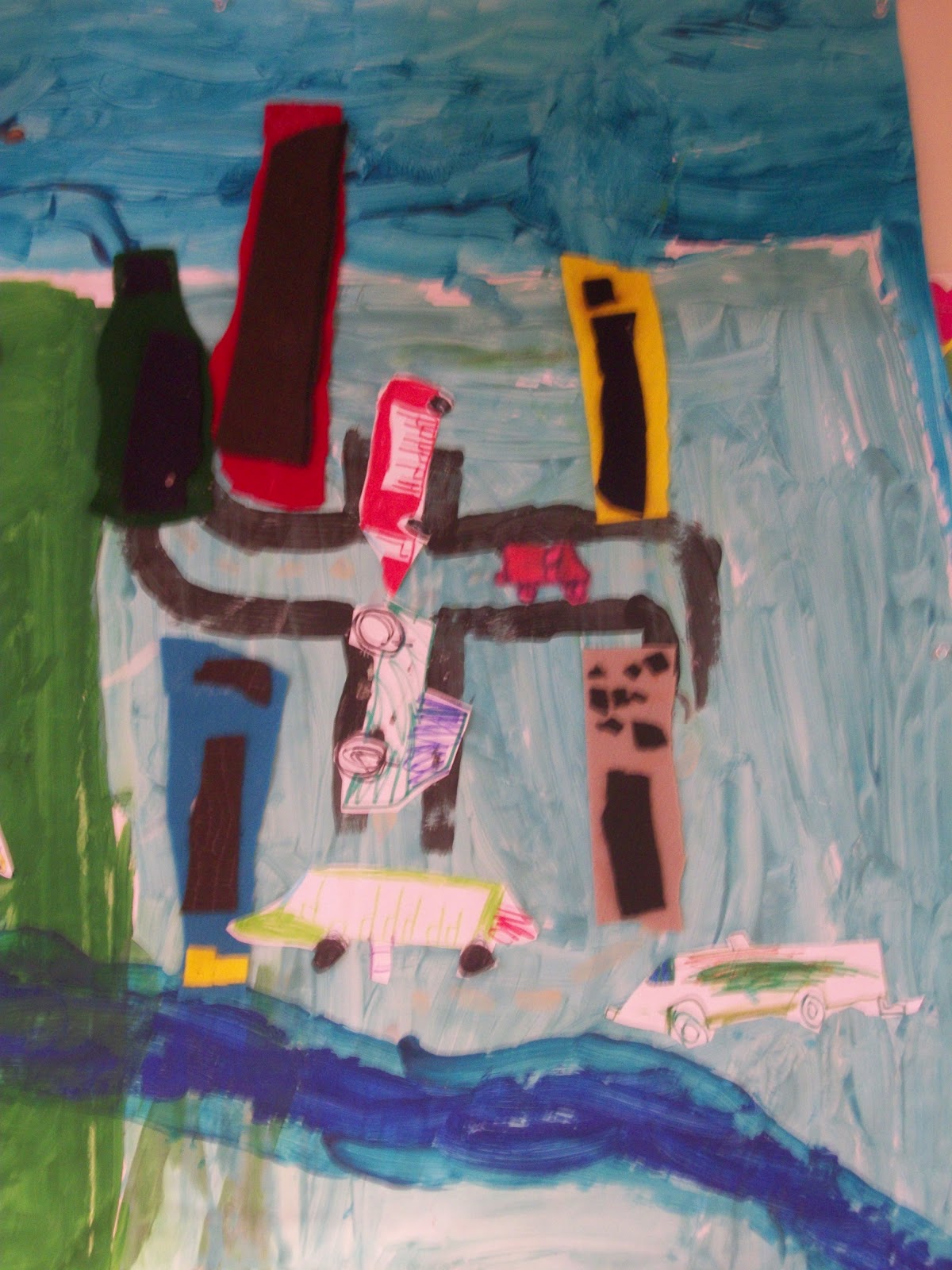
Une fresque sur les paysages d'Afrique

Don't forget to visit the K-1 class blog for more amazing articles! (http://gscpefdm.blogspot.com/)

Nous avons appris que l'Afrique est un immense continent, avec des paysages très différents d'un endroit à l'autre.
We have learned that Africa is an immense continent, with very different landscapes from one place to the other.

Il y a le désert, avec des grandes étendues de sable, quelques oasis, des chameaux, parfois des pyramides ou des bédouins qui vivent dans des tentes, et des crocodiles dans les rivières!
There are deserts, with large areas of sand, a few oasis, camels, sometimes pyramids or Bedouins living in tents, and crocodiles in the rivers!
  

Il y a la savane, comme dans notre livre "Boubam et le tam-tam": beaucoup d'animaux sauvages comme les lions, les zèbres ou les girafes, des rivières où vivent les hippopotames, des villages avec des gens qui aiment parler autour des baobabs.
There is the savanna, like in the book "Boubam and the tam-tam": many wild animals such as lions, zebras or giraffes, and rivers where hippopotamuses live, villages with people talking around baobabs. 


 Il y a aussi la jungle, comme dans l'album "Kirikou et la sorcière": de grandes forêts, beaucoup d'eau et de fleurs, des animaux qui se cachent, comme les singes ou les léopards...
There is also jungle, like in the book "Kirikou": great forests,  a lot of water and flowers, animals hiding, such as monkeys and leopards...


Enfin, il y a aussi de grandes villes, avec de grands immeubles et beaucoup de voitures partout, comme au Caire, où vivent nos correspondants égyptiens. Ils ont de la chance, car le désert et les pyramides ne sont pas loin non plus!
Finally, there are also big cities, with big buildings and a lot of cars everywhere, like in Cairo, where our Egyptian friends are living. They are very lucky because the desert and the pyramids are not very far either!
A partir de ces découvertes, nous avons peint et collé les éléments d'une fresque sur ces différents paysages.
We used these discoveries to paint and glue elements onto a fresque we created to represent those different landscapes.

Tuesday, March 20, 2012

The Benefits of Bilingualism

 
Harriet Russell

SPEAKING two languages rather than just one has obvious practical benefits in an increasingly globalized world. But in recent years, scientists have begun to show that the advantages of bilingualism are even more fundamental than being able to converse with a wider range of people. Being bilingual, it turns out, makes you smarter. It can have a profound effect on your brain, improving cognitive skills not related to language and even shielding against dementia in old age. 

This view of bilingualism is remarkably different from the understanding of bilingualism through much of the 20th century. Researchers, educators and policy makers long considered a second language to be an interference, cognitively speaking, that hindered a child’s academic and intellectual development. 

They were not wrong about the interference: there is ample evidence that in a bilingual’s brain both language systems are active even when he is using only one language, thus creating situations in which one system obstructs the other. But this interference, researchers are finding out, isn’t so much a handicap as a blessing in disguise. It forces the brain to resolve internal conflict, giving the mind a workout that strengthens its cognitive muscles. 

Bilinguals, for instance, seem to be more adept than monolinguals at solving certain kinds of mental puzzles. In a 2004 study by the psychologists Ellen Bialystok and Michelle Martin-Rhee, bilingual and monolingual preschoolers were asked to sort blue circles and red squares presented on a computer screen into two digital bins — one marked with a blue square and the other marked with a red circle. 

In the first task, the children had to sort the shapes by color, placing blue circles in the bin marked with the blue square and red squares in the bin marked with the red circle. Both groups did this with comparable ease. Next, the children were asked to sort by shape, which was more challenging because it required placing the images in a bin marked with a conflicting color. The bilinguals were quicker at performing this task. 

The collective evidence from a number of such studies suggests that the bilingual experience improves the brain’s so-called executive function — a command system that directs the attention processes that we use for planning, solving problems and performing various other mentally demanding tasks. These processes include ignoring distractions to stay focused, switching attention willfully from one thing to another and holding information in mind — like remembering a sequence of directions while driving. 

Why does the tussle between two simultaneously active language systems improve these aspects of cognition? Until recently, researchers thought the bilingual advantage stemmed primarily from an ability for inhibition that was honed by the exercise of suppressing one language system: this suppression, it was thought, would help train the bilingual mind to ignore distractions in other contexts. But that explanation increasingly appears to be inadequate, since studies have shown that bilinguals perform better than monolinguals even at tasks that do not require inhibition, like threading a line through an ascending series of numbers scattered randomly on a page. 

The key difference between bilinguals and monolinguals may be more basic: a heightened ability to monitor the environment. “Bilinguals have to switch languages quite often — you may talk to your father in one language and to your mother in another language,” says Albert Costa, a researcher at the University of Pompeu Fabra in Spain. “It requires keeping track of changes around you in the same way that we monitor our surroundings when driving.” In a study comparing German-Italian bilinguals with Italian monolinguals on monitoring tasks, Mr. Costa and his colleagues found that the bilingual subjects not only performed better, but they also did so with less activity in parts of the brain involved in monitoring, indicating that they were more efficient at it. 

The bilingual experience appears to influence the brain from infancy to old age (and there is reason to believe that it may also apply to those who learn a second language later in life). 

In a 2009 study led by Agnes Kovacs of the International School for Advanced Studies in Trieste, Italy, 7-month-old babies exposed to two languages from birth were compared with peers raised with one language. In an initial set of trials, the infants were presented with an audio cue and then shown a puppet on one side of a screen. Both infant groups learned to look at that side of the screen in anticipation of the puppet. But in a later set of trials, when the puppet began appearing on the opposite side of the screen, the babies exposed to a bilingual environment quickly learned to switch their anticipatory gaze in the new direction while the other babies did not. 

Bilingualism’s effects also extend into the twilight years. In a recent study of 44 elderly Spanish-English bilinguals, scientists led by the neuropsychologist Tamar Gollan of the University of California, San Diego, found that individuals with a higher degree of bilingualism — measured through a comparative evaluation of proficiency in each language — were more resistant than others to the onset of dementia and other symptoms of Alzheimer’s disease: the higher the degree of bilingualism, the later the age of onset. 

Nobody ever doubted the power of language. But who would have imagined that the words we hear and the sentences we speak might be leaving such a deep imprint? 

Yudhijit Bhattacharjee is a staff writer at Science.
This article has been revised to reflect the following correction:
Correction: March 20, 2012

An earlier version of this article misspelled the name of a university in Spain. It is Pompeu Fabra, not Pompea Fabra.

Menu March 19 to March 23, 2012


Monday
Baked Beans
Hot dogs
Coleslaw
Fruit & yogurt

Tuesday
Chicken and vegetable stir-fry
Rice
Cookie

Wednesday
Macaroni & Cheese
Salad
Peas
Apples

Thursday
Chicken & cheese quesadilla
Corn
Mexican rice
Cookies

Friday
Pizza
Salad
Fruit

All meals are served with milk and water.

Friday, March 16, 2012

Elodie- Merci Beaucoup pour ton travail en Haïti!

On behalf of L'Ecole Française du Maine, we would like to thank Elodie LeNezet for her volunteer work in Haiti over the spring vacation. Her work is admirable and inspiring, and we look forward to seeing the photos and hearing all about her trip!

Elodie spent her vacation working with teachers in Haiti to help them teach more effectively to large classes, of sometimes as many as 70 children per class, in limited conditions. Please take a moment to thank Elodie personally for this amazing volunteer effort when you see her!

As you may know, L'Ecole Française du Maine sponsored this trip. We want to thank those of you who have already contributed to this important cause.

It is not too late to help!

Although we did receive many generous contributions, we did not reach our goal of covering the expenses of flights to Haiti and vaccinations.

We needed to raise $1,950 to cover actual costs, and so far we have raised $920. While this is a great start, we still have a way to go.

Should we surpass our goal of covering actual expenses, any proceeds will go towards sponsoring children at the school where Elodie volunteered. For just $225 you can sponsor a child for a whole year, including education, school uniform and a lunch each day!

We want to thank the families in the K-1 class who worked together and gave solar-powered BoGo lights as a class. It was wonderful to involve the children in this effort.

Thanks also to all of you who donated sharpies and highlighters as requested. You cannot imagine how such a small gesture can make such a big difference!

Special thanks go to the following families and friends who have already made monetary contributions:

Faulstich, Devlin, Doolan, Welsher,
EFDM Parents' Association, Merchi, LeBihan, Hannigan, Bickerstaff, Brewer, Neuschiller, Levesque, Legall, and Mechtenberg

Elodie has already expressed interest in returning to Haiti in the near future to continue this work, and we completely support her! We must not forget the difficult situation in Haiti. Even though it no longer is covered in the press, the challenges are as present as ever. Let's all pull together and make a difference!

Thank you again Elodie for being so giving of yourself and your talent as a teacher for such a worthy cause!

*L'Ecole Française du Maine is a non-profit corporation 501(c) 3, and all donations are tax-deductible. Thank you!

Chanson française à Portland, Maine

Monday, March 12, 2012

Ciné-club March 21 at 6:30PM


Come enjoy the opportunity to socialize in French and English and see a great French movie (in French with English subtitles).
6:30PM: Conversation, food and drinks
7:00PM: Start of the film


Movie: Crime d'amour
Un film de Alain CORNEAU, 2009,  thriller, avec Ludivine SAGNIER, Kristin SCOTT THOMAS, Patrick MILLE,  Guillaume MARQUET…

Synopsis : Ruthless executive Christine brings on Isabelle as her assistant, and she takes delight in toying with the young woman's innocence. But when the protégé's ideas become tempting enough for Christine to pass one as her own, she underestimates Isabelle's ambition and cunning -- and the ground is set for all out war.

Menu March 12 to March 16, 2012


Monday
Chicken rice casserole
Broccoli
Cookies

Tuesday
Grilled Ham & cheese
Pasta & veggie salad
Fruit & yogurt

Wednesday
Potato Cheddar Soup
Caesar salad
Baguette
Cookie

Thursday
Spaghetti w/ mini meatballs
Salad
Garlic bread
Grapes

Friday
St Patty’s Day Dinner!

All meals are served with milk and water.

Tuesday, February 28, 2012

Nos prénoms en hiéroglyphes

Don't forget to visit the K-1 class blog for more amazing articles! (http://gscpefdm.blogspot.com/)

Après quelques lectures documentaires sur le monde de l'Egypte antique, les élèves de la classe ont écrit leur prénom en hiéroglyphes grâce à un alphabet spécial.
After reading documentaries about ancient Egypt, the children of the class wrote their first names in hyeroglyphics thanks to a special alphabet.


Ce n'était pas facile, car certaines lettres étaient très complexes à tracer. It wasn't easy because some letters are very complex to write.

Mais tout le monde s'est appliqué et le plus difficile maintenant, c'est de réussir à traduire les prénoms... But everyone took great care and the most difficult part now is for us to be able to translate the names...
Qui saura retrouver le travail de son copain ou de son enfant?
Who will be able to find the work of their friend or child?

Monday, February 27, 2012

Cabin Fever?

Join the South Freeport Church Community for "Cabin Fever Cure"
on Saturday, March 24 for a "Bean Suppah" & Family Bingo.
 Dinner is $7 for adults and $5 for children  and includes beans, hotdogs,  coleslaw, homemade pies and beverages.

Dinner will be served from 5 to  6:30 pm.

 Family bingo begins at 6:30 pm.   Bingo cards cost 25 cents  each.
For more information call the South Freeport Church at 865-4012. 

De grands travaux

Don't forget to visit the K-1 class blog for more amazing articles! (http://gscpefdm.blogspot.com/)

Ces dernières semaines, la neige est tombée, a gelé, a fondu... L'occasion pour les enfants d'observer les différents états de l'eau et surtout de jouer avec!
For the past few weeks snow fell, froze, and melted... It was a great opportunity for children to observe the different states of water, and most of all, to play with it!

La cour de récréation étant finalement envahie par de grandes flaques d'eau, de grands travaux ont été entrepris par tous les élèves de l'école. Ils ont beaucoup discuté pour trouver le moyen d'évacuer l'eau et la solution retenue a été celle du détournement afin d'irriguer la forêt!
In the end, the playground was covered with big puddles of water, and all the children of the school started great works. They discussed the best way to evacuate the water and a solution chosen was to divert it in order to irrigate to the forest!
A chaque récréation, tout le monde s'attelle à la tâche, les petits comme les grands: tranchées à creuser, circuits à tracer, solutions pour écoper. Ils déploient des trésors d'ingéniosité et de patience pour ce grand projet.
During every recess everyone gets to work, the little children and the big ones: digging trenches, creating circuits, finding solutions to bail out. They used a lot of ingenuity and patience for this project.
Alors c'est certes très salissant, mais aussi très gratifiant et amusant! Bravo à tous! It is of course very messy, but also very rewarding and a lot of fun!

Sunday, February 26, 2012

La salle des profs


Now that the children are having lunch at Provisions, the school kitchen has been turned into a staff room. Yesterday, Beth and Willy prepared a delicious breakfast for all of us, complete with beautiful flowers to decorate our new space. 
Merci beaucoup! We appreciate it very much!