Sunday, June 3, 2012

Glaciology at Winslow Park

Students in grades 2 and 3 have been studying the work of Louis Agassiz who proposed in 1837 that much of North America had been subject to an Ice Age 10,000 years ago with the Laurentide Ice Sheet covering much of New England.  Agassiz made his demonstration using field obsevations, and some of them were completed in Maine soon after he was appointed at Harvard University.  Our students went to Winslow Park in Freeport as "detectives" to collect evidence that would justify -or not - such a paradigm that revolutionized modern science.

Roches moutonnées
In glaciology, a roche moutonnée (or sheepback), is a rock formation created by the passing of a glacier. The passage of glacier ice over underlying bedrock often results in asymmetric erosional forms as a result of abrasion on the 'stoss' (up-ice) side of the rock and plucking on the 'lee' (down-ice) side. These erosional features are seen on scales of less than a meter to several hundred meters.
A student is pointing in the direction of the ice movement that created the asymetrical feature of this texbook example of Roche Moutonnée. 

Grooves and striations
Students found numerous striations, scratches, gouges and grooves cut into the pegmatites and gneiss of Casco Bay formation.  They appeared parallel orientated South West.  They were formed by the movement of glaciers using rock fragments as abrasive and cutting tools.

Erratic boulders and dropped stones
Students compared the lithology of this boulder with the surounding bedrock. It appeared foreign and it was determined to be a potential suspect erratic boulder transported by the ice or included in the moraine till currently being eroded by sea action- a great find by our young glaciologists.

Coquina sand and isostasic rebound
Students discovered sand composed of 90% of sea shells with 10% of various rock debris.  The concept of isostasic rebound was introduced to the surprise of the students.

Smooth and glacial polish surfaces
Rocks were found to have been smoothed by the abrasive action of the ice.  On many outcrops, the surfaces were covered with striations, fractures and grooves that further demonstraded the glacial erosion.  Out student-detectives found numerous evidences that glaciers played an important role in shaping present-day Winslow Park.

Glaciology is so "groovy"

Friday, June 1, 2012

Explore the outdoors:


Comme un boomerang

Don't forget to visit the K-1 class blog for more amazing articles! (http://gscpefdm.blogspot.com/)

Le boomerang est à l'origine une arme de chasse des Aborigènes, les natifs d'Australie. Ils s'en servent également comme d'un instrument de musique, mais aujourd'hui, tout le monde connaît le boomerang comme un jeu de lancer.
Boomerangs are originally a hunting weapon of the Aborigine, the native people of Australia. They also use it as a musical instrument, but today everyone knows the boomerang as a throwing game.

Nous avons peint nos boomerangs avant de les décorer, avec des graphismes et des dessins d'animaux présents dans l'art aborigène, car on les trouve dans le bush, le nom de la savane en Australie et en Nouvelle-Zélande, ou dans l'océan.
We painted our boomerangs before decorating them, with shapes and animal drawings present in the Aborigine art because they are found in the bush, which is the name of the savannah in Australia and New Zealand, or in the ocean.
Nous avons peint des geckos, des tortues, des serpents ou des poissons. We painted geckos, turtles, snakes or fishes.

Tout le monde s'est bien appliqué car ce travail était très minutieux! Everyone took great care and did detailed work!
On aurait bien essayé de faire voler nos boomerangs, mais Yassine a préféré les suspendre pour décorer le couloir! We would have loved to try and make our boomerangs fly, but Yassine preferred to hang them to decorate the hall!
 

Les croix méxicaines de CE1 / CE2


Mexican cross, Peruvian or Cran Chaco cross... Decorative or magic according to traditions, with its vivid colors and symmetric forms, the Mexican cross brings to mind Native American art. Children of the 2nd and 3rd grade class had to find two strait sticks on the playground and learn a technique of weaving the wool yarn around the cross.

La motricité en maternelle

The preschool children have been working hard on their gross motor skills. You can see them on the photos practicing throwing balls into hoops and in the video they are doing a relay race! This is so much fun!

On s'amuse bien à la garderie!


Everyday, between 3:30PM and 5:30PM, children of all grades meet in afterschool care. They start with a little snack and then take advantage of their time in “garderie” to run, play, talk, draw, and do their homework…
It is a good time for the students to share games with friends of their class or with children of different age groups. According to the weather, aftercare is offered inside or outside on the playground.
Outside, the older children organize sports competitions for the younger ones, pull sleds, children play ball, play with trucks, build forts or fairy houses…
Inside, children make dinner in the play kitchen, play with cars, Legos, prepare meals out of play-doh, do puzzles, do collages and drawings, create puppet shows and they even dance sometimes!
This is so much fun that when mom and dad arrive, the children find it difficult to leave, they want to stay just a little bit longer or they go hide in hopes to stay at school all night!
Many thanks go to Philomene who has been running the garderie this year to the great pleasure of the children and parents!

Les jardins japonais

In art class CE1/CE2 students (grades 2-3) were introduced to the notion of a Japanese garden. First we have talked about its components and then we went outside to build our Japanese gardens. The available material consisted of rocks found during our outing at the Topsham quarry, sticks, branches, flowers, pine cones found in abundance in the woods, sand, water and plastic bags to build a pond. Here are the pictures of our marvelous creations: 

Le B2i: Brevet informatique et internet


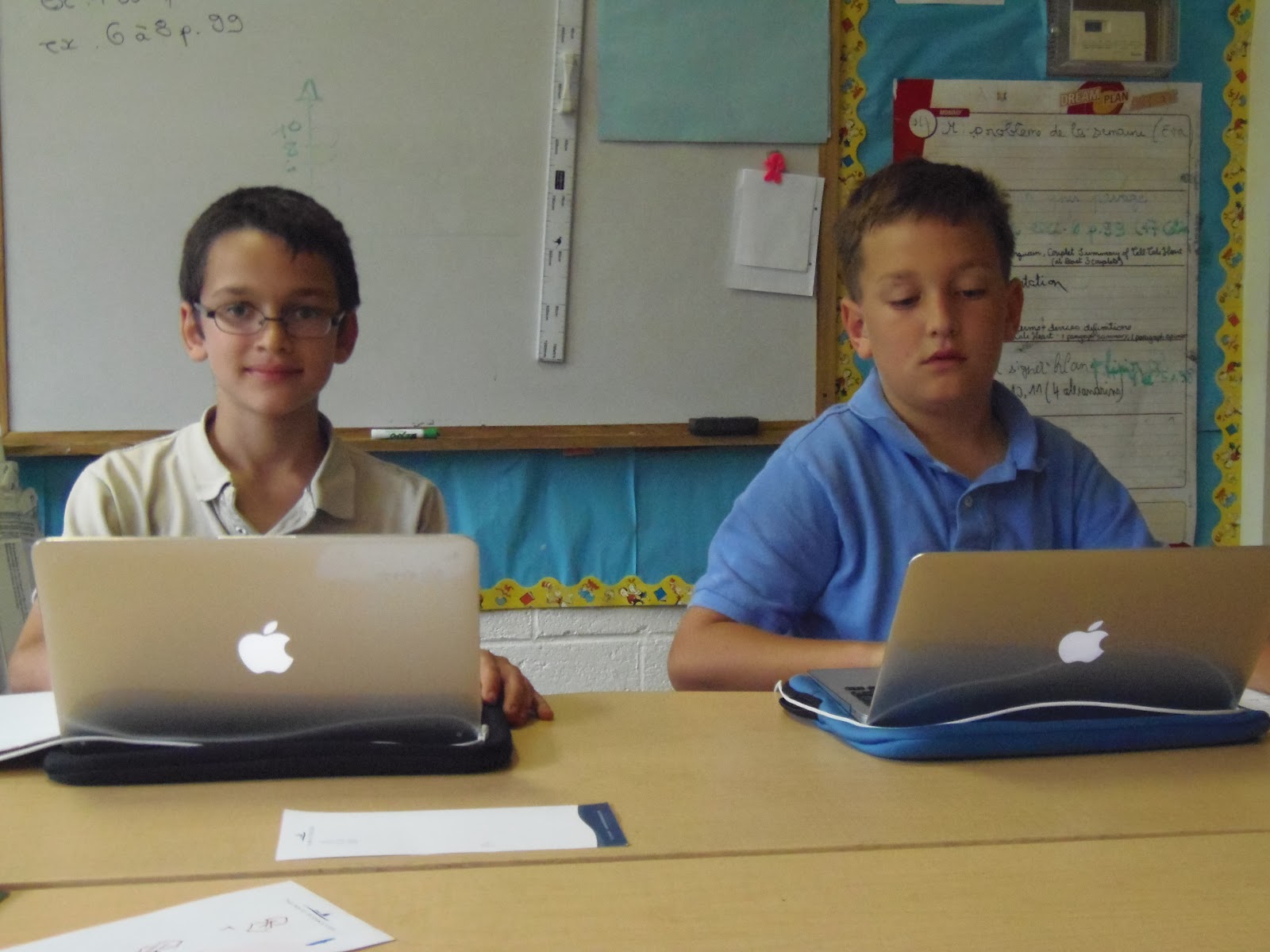
In Technology Class, the 5th Graders are currently working hard in order to fulfill the requirements of the B2i école. In accordance with the French Curriculum, each student must demonstrate basic knowledge of the Internet and the use of the computer by the end of 5th grade. The competencies are tested independently. They include typing skills, effective internet researching, and critical use of the internet . The students will receive diplomas upon completion.