Saturday, October 5, 2013

Une classe remplie de tournesols- (CE2/CM1)

At the end of his life, Vincent Van Gogh painted a serie of paintings with sunflowers in vases, which are part of his most famous works.
During this project students learned how to use the color wheel to mix different hues and tints of a color.


There is a certain mystery surrounding the paintings.

It is believed that Van Gogh painted them to use as gifts for his friends, painters whom he had been inviting over to stay, and whom would never come.

It is also possible that there could be other paintings of sunflowers somewhere, not yet discovered ... it may well be one of these!


CE2- Des arbres généalogiques poussent dans notre classe

This year, the CE2 are officially starting to study History. Right from the start: the Préhistoire. 
The concept of time passing by is a hard one to grasp and so we started working on family trees to give them a sense of time. 


They did research, found photos and built their family trees.


Their own pictures were the trunk, then they added mom and dad and moved up from there.


Come check out the forest in the classroom!

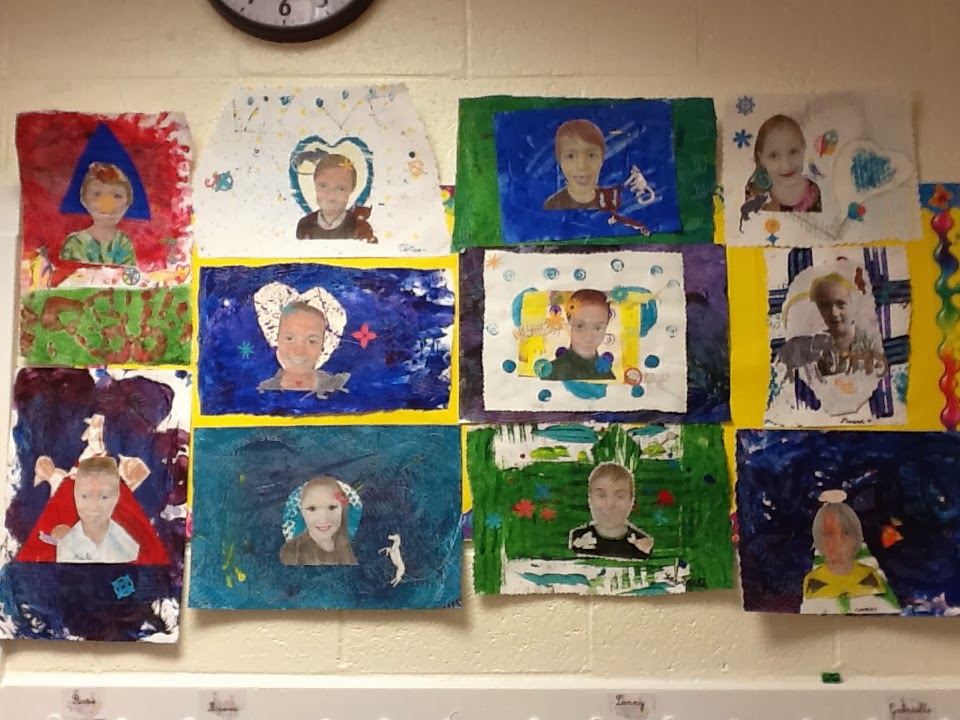
Self-portrait in style of Frida Kahlo (CP/CE1)


This was a multistep project. First the children had to experiment with different ways to apply paint to paper. We talked about how to create patterns using unusual instruments (toothbrush, hair comb, pencil eraser, wine cork, bubble wrap...to name a few).
Then each took a step-by-step approach and drew two of their favorite animals. 


After that a black-and-white photo was colored in a realistic way with color pencils.


Finally everything was assembled in a nice-looking collage. 
A few flower accents and a nice edge were added to complete the artwork.

Ce2 – Une maîtresse qui fait mes tresses.


The Ce2 read an extract from a great children's book author, Pierre Gripari. He always writes very funny stories that take place in Paris, in the rue Mouffetard, with witches and strange characters.

Une jardinière qui jardinait hier.
Une dentiste qui fabrique des dents tristes.
This extract tells the story of a few inhabitants of this street. When describing these people, Gripari plays with words of professions and ends up having a definition that does not fit the profession at all, except with the pronunciation.

Une actrice qui fait des arcs tristes
Un marchand qui marche dans le champs

The students based their work on these and created their own definitions. You can come check them out in the hallway and try to understand the definitions.


Une maîtresse qui fait mes tresses

The CM2 and 6th grades have seen the world today !

In geography, we studied the Earth's representations' evolution through the centuries.
Today, thanks to the satellites, we are able to see very detailed images of our planet.

To complete our studies, we went to Delorme inYarmouth, Maine.
DeLorme produces market-leading GPS, digital maps, and mapping software solutions for government, military, businesses, and consumer markets.


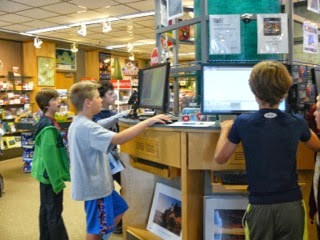
Children in front of Eartha
We have seen the world today thanks to Eartha.
Eartha is a 3-dimensional scale model of our earth with mountains and landforms in full 3D, that rotates and revolves, simulating the Earth’s real movements. Eartha was given the title of "World's Largest Revolving/Rotating Globe" by the editors of the Guinness Book of World Records in 1999, and still holds that record today. It measures 41.5 ft in diameter.

The children watched a movie about  Eartha's construction. Unveiled July 23, 1998 Eartha took two years to build and represents Earth as it is seen from space. It rotates and revolves on a specially designed and built mechanized, cantilever arm.

The children had the chance to practice finding L'Ecole Française du Maine with some new software.

After school club: Visual arts


A l' Ecole Française du Maine, we are offering some fun activities after school:


 This week, in visual art club, we had fun face painting


Some children chose to have scary faces...


While others chose cute animals..


Friday, September 20, 2013

Rocket Launch!

The CP/Grade 1 class built a rocket in science using a plastic bottle, water and a bicycle pump. We launched the rocket this afternoon, and as you will see in this video- it really took off!!!


Biking at Wolfe Neck Farm

Students in grades 2-6 had a wonderful time biking at Wolfe Neck Farm.
The setting was beautiful- biking along with ocean views.  

Whether just learning or experienced, the bikers all found enjoyment in this special outing! 


Thanks go to the chaperones who came along, to Thornton the bus driver for the use of his truck and trailer, and to the parents for delivering the bikes to school for the trip. 


 It could not have been a more perfect day!

Apple Picking field trip for preschool and kindergarten

The preschool and kindergarten children went apple picking - and it was a beautiful day! 

 Parents, teachers and children enjoyed walking through
the apple orchard at Sweetser's Farm in Cumberland. 

 After picking the apples and seeing how they are sorted, we brought the apples back to the school.
We have many fun (and delicious) activities planned for the apples we picked today!

Painting with little feet!

You already know how well we can paint with our hands...
but did you know we could paint with our feet too?
 

Yes, we can- and it is a lot of fun too!

Thursday, September 19, 2013

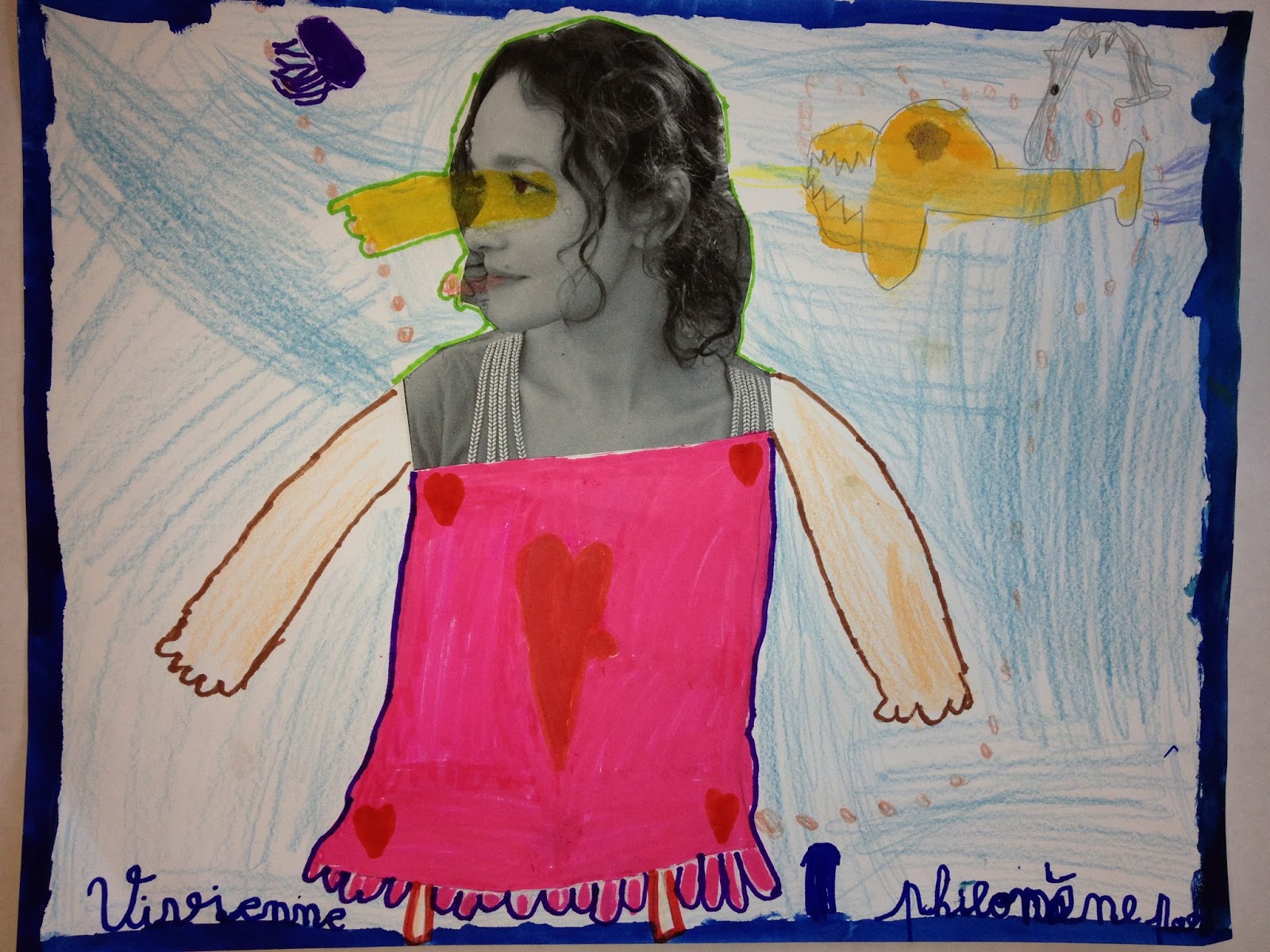
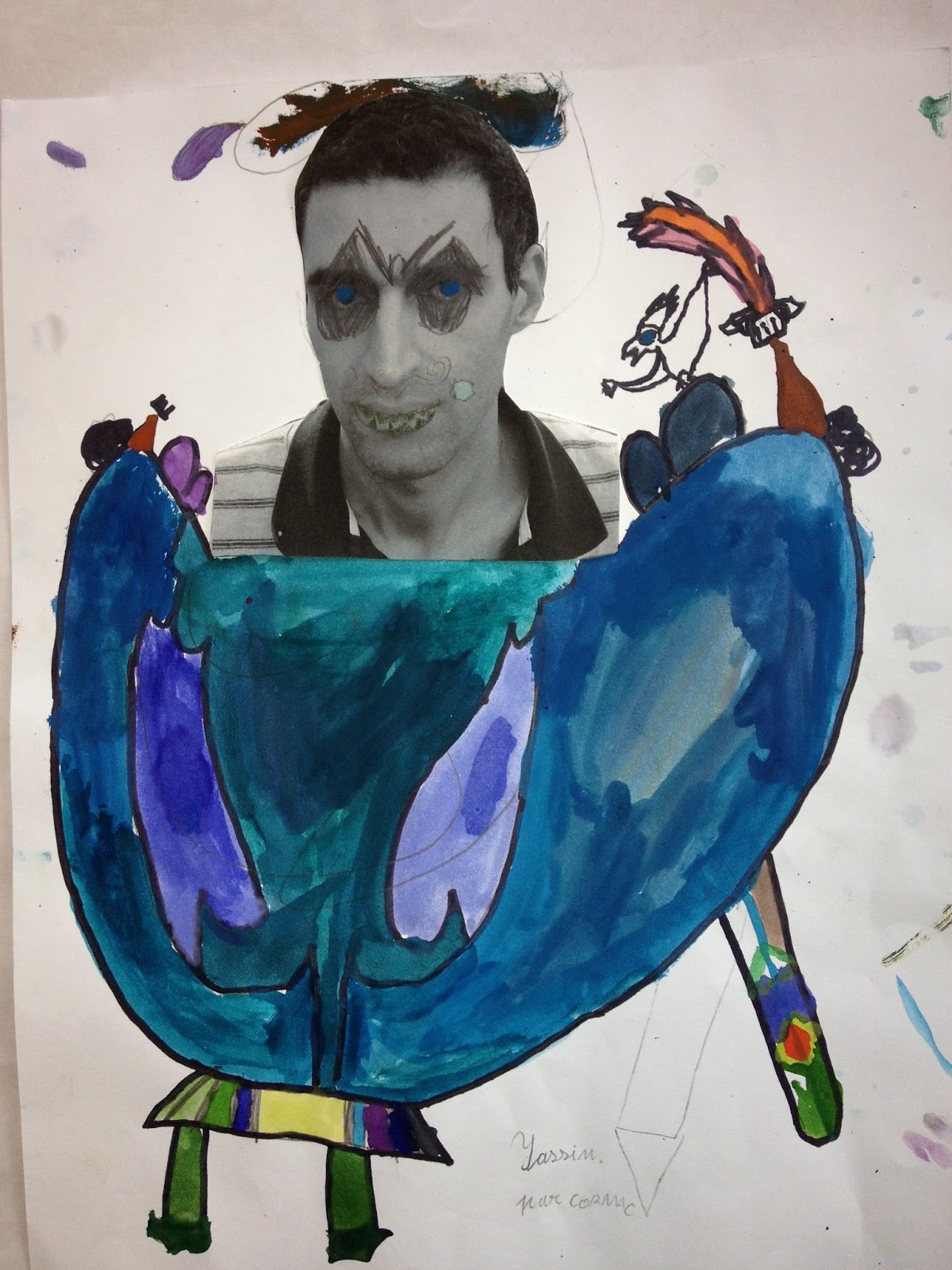
Les instituteurs vus par la classe de CP à la façon de Mica Angela Hendricks


Mica Angela Hendricks, professional illustrator from Alaska, has been collaborating with her 4-year-old daughter on a series of wonderful drawings. They pass back and forth between mother and daughter until reaching an always unexpected final form.

Each drawing begins with Hendricks drawing a detailed retro-ish head, after which her daughter snatches away the sketchbook to create rudimentary body (or animal!) parts as well as other random details.
Afterward Hendricks goes back in to polish things up a bit. Inspired by the work of the artist and her daughter, children of CP and CE1 classes created these caricatures of the EFDM teachers.
Starting with a black and white picture of a teacher, students used their imaginations to add their own contributions.


This is a way that we could never think of ourselves!!! 

Thank you !!

Dear Parents Association:
Your gift of the Cricut craft machine is deeply appreciated!
We are using it constantly to decorate bulletin boards and for creative classroom projects.
We love it! Merci beaucoup!!!
-The entire staff of EFDM

Open house on 0ct.5th, 11:00 am-2:00 pm


Monday, September 16, 2013

La chanson de l'alphabet- Chorale des petits

La chorale des petits 

Close buy fundraiser is underway!

Dear Friends and families,

Again this year, L'Ecole Française du Maine is taking part in the fundraiser for schools- Close buy, featuring lots of Maine-made products including: delicious foods, jewelry, artwork, housewares, clothing, kids' items, stationary, pottery - and much more!

The School will receive 30% of the proceeds of the items purchased, so please join us in supporting local artists and companies while benefitting the school!


Please tell your friends- they can order online  at www.closebuycatalog.com and select L'Ecole Française du Maine as the benefitting school! 
Close Buy Parent Party on September 25th at 3:15pm- Please join us!

Join us for a “Close Buy Parent Party”, featuring wine, (generously donated by Jen Ely of USA Wine West – merci!) and cheese. We’ll be meeting across the street from school at the Community Hall of South Freeport Church.  There, we’ll have a chance to mingle and catch up with other families as we look over of some of the products available through Close buy.

As an extra enticement to attend- the School will offer childcare during the reception at no cost so you can relax and enjoy! Please let us know via email if you will attend and if you need this service so we can plan accordingly.

Catalog orders need to be returned to the school by September 30th, 
Online ordering ends October 10th. 
Everything will be delivered in time for the holidays.

Thanks for placing your orders and for your support!!!!

Cursive writing is not a lost art at L'Ecole Française du Maine - Here is an article showing why this is good news!


What Learning Cursive Does for Your Brain
Cursive Writing Makes Kids Smarter

Psychology Today
Published on March 14, 2013
by William R. Klemm, D.V.M, Ph.D. in Memory Medic

Ever try to read your physician’s prescriptions? Children increasingly print their writing because they don’t know cursive or theirs is unreadable. I have a middle-school grandson who has trouble reading his own cursive. Grandparents may find that their grandchildren can’t read the notes they send. Our new U.S. Secretary of the Treasury can’t (or won’t) write his own name on the new money being printed.

When we adults went to school, one of the first things we learned was how to write the alphabet, in caps and lower case, and then to hand-write words, sentences, paragraphs, and essays. Some of us were lucky enough to have penmanship class where we learned how to make our writing pretty and readable. Today, keyboarding is in, the Common Core Standards no longer require elementary students to learn cursive, and some schools are dropping the teaching of cursive, dismissing it as an “ancient skill.”[1]

The primary schools that teach handwriting spend only just over an hour a week, according to Zaner-Bloser Inc., one of the nation's largest handwriting-curriculum publishers. Cursive is not generally taught after the third grade (my penmanship class was in the 7th grade; maybe its just coincidence, but the 7th grade was when I was magically transformed from a poor student into an exceptional student).

Yet scientists are discovering that learning cursive is an important tool forcognitive development, particularly in training the brain to learn “functional specialization,”[2] that is capacity for optimal efficiency. In the case of learning cursive writing, the brain develops functional specialization that integrates both sensation, movement control, and thinking. Brain imaging studies reveal that multiple areas of brain become co-activated during learning of cursive writing of pseudo-letters, as opposed to typing or just visual practice.

There is spill-over benefit for thinking skills used in reading and writing. To write legible cursive, fine motor control is needed over the fingers. Students have to pay attention and think about what and how they are doing it. They have to practice. Brain imaging studies show that cursive activates areas of the brain that do not participate in keyboarding.

Much of the benefit of hand writing in general comes simply from the self-generated mechanics of drawing letters. During one study at Indiana University to be published this year,[3] researchers conducted brain scans on pre-literate 5-year olds before and after receiving different letter-learning instruction. In children who had practiced self-generated printing by hand, the neural activity was far more enhanced and "adult-like" than in those who had simply looked at letters. The brain’s “reading circuit” of linked regions that are activated during reading was activated during hand writing, but not during typing. This lab has also demonstrated that writing letters in meaningful context, as opposed to just writing them as drawing objects, produced much more robust activation of many areas in both hemispheres.

In learning to write by hand, even if it is just printing, a child’s brain must:
Locate each stroke relative to other strokes.
Learn and remember appropriate size, slant of global form, and feature detail characteristic of each letter.
Develop categorization skills.

Cursive writing, compared to printing, is even more beneficial because the movement tasks are more demanding, the letters are less stereotypical, and the visual recognition requirements create a broader repertoire of letter representation. Cursive is also faster and more likely to engage students by providing a better sense of personal style and ownership.

Other research highlights the hand's unique relationship with the brain when it comes to composing thoughts and ideas. Virginia Berninger, a professor at the University of Washington, reported her study of children in grades two, four and six that revealed they wrote more words, faster, and expressed more ideas when writing essays by hand versus with a keyboard.[4]

There is a whole field of research known as “haptics,” which includes the interactions of touch, hand movements, and brain function.[5] Cursive writing helps train the brain to integrate visual, and tactile information, and fine motor dexterity. School systems, driven by ill-informed ideologues and federal mandate, are becoming obsessed with testing knowledge at the expense of training kids to develop better capacity for acquiring knowledge.

The benefits to brain development are similar to what you get with learning to play a musical instrument. Not everybody can afford music lessons, but everybody has access to pencil and paper. Not everybody can afford a computer for their kids−maybe such kids are not as deprived as we would think.

Take heart. Some schools just celebrated National Handwriting Day on Jan. 23. Cursive is not dead yet. Parents need to insist that cursive be maintained in their local school.

La chenille qui fait des trous d'Eric Carle

In grande section, we read "La chenille qui fait des trous" d'Eric Carle. 
We observed the food it is eating in a very particular way: we practiced our senses.
We tried to recognize each fruit with our sense of touch..
Is it an apple, an orange, a pear, a prune, a strawberry?
Is it small, round, oblong, flat, rough?
Then we practiced our taste the same way!
It was really fun!!