Friday, January 25, 2013

Building Addition Inauguration January 31, 2013 at 2:30 pm

You are cordially invited

 Thursday, January 31 at 2:30PM

to the inauguration of the new classroom and entrance of
L’Ecole Française du Maine

Consul General of France, Fabien Fieschi will officiate the event. 
Following the ribbon cutting ceremony, 
the Consul General will issue the full accreditation certificate by the 
French Ministry of Education (pre-school through grade 5).

A reception is planned by the Parents’ Association.

RSVP: (207) 865-3308

Thursday, January 24, 2013

Wednesday, January 23, 2013

2nd and 3rd graders à la découverte de Jean-François Millet et du réalisme

Students are learning about realism and Jean-François Millet 's work.

We took and printed a picture of each student doing a realistic task in the class.
(getting the mail, carrying the sport equipment, watering the plants, erasing the board, writing. .)


Students had to study their own picture and 
really focus on the details like the colors, the position of their body.


                     Then, students realized a painting, trying to figure out how to come up with the same colors and detail. 


Tuesday, January 22, 2013

The Art of Shadow and Light ou l'ombre et la lumière

The real key to making shadow art isn’t the shadow itself, but the light and the objects blocking the light that eventually come together to make an image in the darkness. This lesson is very important in the CE1 and CE2 's curriculum. The students had to figure out how to draw light and shadow. 


First of all, they practiced with a pencil: starting with a white shape, they gradually added some shadow until they eventually got to the darkest shade of grey.


 The second practice was to do the same exercise with paints. They mixed white paint with a solid color to create some real nice palettes. 


 Finally, they were ready to apply the
  shadow and light techniques
 they practiced
  to paint pictures of  fruits.                                     


They also learned the primary, 
secondary 
and  
  tertiary colors. 


Check out our great art work featuring apples, pears, peaches and bananas.

CM1-CM2: A la manière de Winslow Homer


So this is the last of our beautiful projects on Winslow Homer.
The students selected one piece seen at the exhibition at the Portland Museum of Art and skethed it beautifully, playing with the subtleties of the paintings, shades and light. They later painted it with a mix of watercolor and paint.

The results are absolutely amazing.
Come check them out on the walls in the hallway.


Thursday, January 17, 2013

"C’est bien de…" by the CM1


The students read and studied the book by Philippe Delerm, C’est Bien, which is a great collection of short stories, all dealing with little pleasures in everyday life.


In class, we discussed those little things we like to do, may it be baking a cake or reading a book by the fire, or watching a movie when it is raining.

Each student chose one moment that he/she likes and wrote about it, trying to recreate on paper the feelings, the joy, the excitement that it brings to them. They also illustrated their short story.


They are on display in the classroom.

Les CP font du pain


In class, the children read the book " la petite poule rousse". At the end of the story, la petite poule rousse is making bread. The children studied the recipe and learned about the role of yeast while making bread. 


First we mixed the flower and the salt,
then we added the yeast and some hot water, then we
kneaded the dough for 20 minutes until it looked like playdough.


Finally we shaped the dough like baguettes, crowns or little men.


And if you want to know our secret for a very crusty baguette, put some water on it and put in the oven for 25 minutes.

Enjoy!!!

Le livre des couleurs par les maternelles


The children in maternelle have been working really hard to create their book of colors. They are very proud to share it with you.

Tuesday, January 15, 2013

Les grottes de Lascaux

In history class, the CE2 is studying prehistory and the very famous caves of Lascaux.


  Lascaux is the setting of a complex of caves in southwestern France famous for its Paleolithic cave paintings. The original caves are located near the village of Montignac, in the department of Dordogne.


 The students learned how the caves were discovered, why there are paintings on the walls and what they represent. The children worked in groups to create their own posters.


Wednesday, January 9, 2013

Meet Peter Dugas, Piano Teacher


L'Ecole Francaise du Maine is  thrilled to announce that Peter Dugas will be joining its faculty as piano teacher in addition to Leah Neuchiller,  now a busy graduate student in Music Education.  Peter is accepting students of various level. A meeting for prospective families has been scheduled with Peter and Leah on Thursday, January 17 at 3:00 pm in the school office. Peter Dugas has been playing and teaching classical and jazz piano professionally for over fifteen years. He has been a fixture in Portland’s music scene and has played in a variety of styles from jazz to classical to pop. He has performed throughout the northeast and in Finland, Germany and France.  He has studied classical piano with Eleanor Carter and Laura Kargul and has studied jazz with Daryl Rhodes, Craig Najjar and Tom Snow. He holds a bachelor’s degree from the University of Southern Maine in Jazz Performance and previously holds a bachelor’s degree from Brown University.  Peter lives in Portland, Maine with his wife and daughter. He maintains a busy teaching studio and performs throughout New England.

Thursday, December 27, 2012

L'Ecole New Video: The Paths We Choose


SOURCES:
1. According to the neuropsychologist, Eric Lenneberg, in his book Biological Foundations of Language, 1967, the capacity to learn a language is indeed innate, and, like many such inborn mechanisms, it is circumscribed in time. If a child does not learn a language before the onset of puberty, the child will never master language at all. This is known as the critical period hypothesis. This research was from a lecture given by Timothy Mason at the Université of Versailles, St. Quentin. It is available here:http://www.timothyjpmason.com/WebPages/LangTeach/Licence/CM/OldLectures/L3_ExtremeCircs.htm

2. An interview with Dr. Bialystok summarizes her findings. It is available here:   http://www.guardian.co.uk/technology/2011/jun/12/ellen-bialystok-bilingual-brains-more-healthy

The NY Times also profiled Dr. Bialystok, which is available here:

3. According to Dr. Wilder Penfield and Dr. Lamar Roberts, Co-Authors, Speech and Brain Mechanisms, the human mind retains a ‘functional plasticity’ for a period of time that lasts from ages 3 to 12. This biological flexibility makes it the optimum time for language learning. More details can be found here: http://en.wikipedia.org/wiki/Critical_period_hypothesis

4. The American Psychological Association studied bilingual speakers. Brain-imaging research has shown that when people switch to another language, their brains make constant use of their executive control network, which involves the dorsolateral prefrontal cortex, anterior cingulate cortex, Broca’s area and the basal ganglia. Working out those brain areas may make these people better able to perform other activities that require switching, such as visual searches where people are asked to find the incongruent image or pattern. The study was summarized on the APA website: http://www.apa.org/monitor/2010/04/language.aspx

5. According to Dr. Laura-Ann Petitto of Dartmouth College, children who have been exposed early to a second language possess an overall "cognitive edge." Numerous studies have also linked language education to higher scores on many standardized tests. A synopsis of the work can be found here: http://www.early-advantage.com/articles/learningtoread.aspx 
Additional details about Dr. Petitto’s work on bilingualism can be found on the Society for Nueroscience website here: http://www.sfn.org/index.aspx?pagename=news_11112003a

Thursday, December 13, 2012

Temps médievaux

Classe de CE1 et CE2 travaillent sur le moyen âge:
 
 The Lady and the Unicorn is often considered one of the greatest works of art of the Middle Ages in Europe. Five of the tapestries are commonly interpreted as depicting the five senses – taste, hearing, sight, smell, and touch. The sixth displays the words "À mon seul désir". This tapestry's meaning is obscure, but is commonly considered as representing love or understanding. 

Students were assigned to work in groups of 8 to reproduce one of the tapestries using felt. They did an outstanding job putting all the elements together, especially because using a glue gun was a challenge at times.
Taste
The lady is taking sweets from a dish held by a maidservant. The lion and the unicorn are both standing on their hind legs reaching up to pennants that frame the lady on either side. The monkey is at her feet, eating one of the sweetmeats.


À Mon Seul Désir
The lady stands in front of a tent, across the top of which is written "À Mon Seul Désir", an obscure motto, variously interpretable as "by my will alone". Her maidservant stands to the right, holding open a chest. The lady is placing the necklace into the chest.


Wednesday, December 12, 2012

Lego Robotics and Mindstorm Programming are coming to the French School

The French school is now offering a Lego Robotics Club: Sandrine and Yassine went trough an intensive training with Tom Bickford, (Executive Director for Maine Robotics) to learn how to build and program robots to do what we want. There are many different steps that the kids are going to learn through the club:
The kids will learn how to build following a plan. Some plans have 70 pages.
 Write a program to make the robot turn, grab, move and even  talk
Et voilà...meet Bob !
We can't wait to have little robots running through the school. This week-end, some of our students went to the Maine FIRST LEGO League Championship at the Civic Center in Augusta. We watched 72 teams competing.  The kids were able to drive some of the high school 's robots.  
If you want to learn more about  Lego Robotics, check out the website at :http://www.mainerobotics.org/


Quelle couleur?


In the preschool class, we are working hard to prepare our book of colors! We are creating one page for each color using different techniques: painting with rollers, sponges, toothbrushes, making imprints of corks, stamping different kinds of papers or cotton.   The "moyenne section" children are also learning to reconstruct and write the names of some colors. We love to look at all the pages that we have already finished and see our book getting built!

Nutcraker Backstage: Maine State Ballet

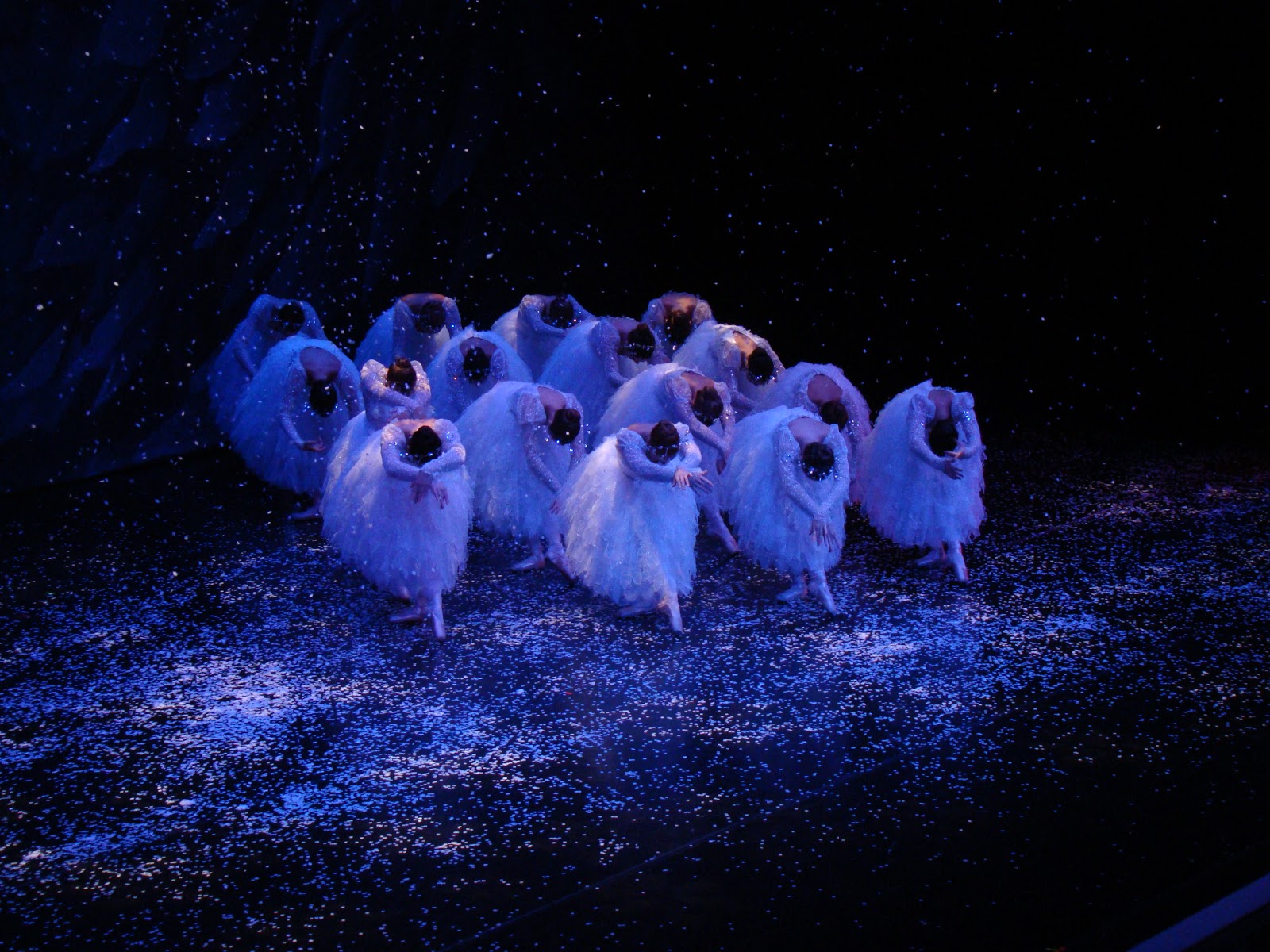
Students in grades 2, 3, 4 and 5 went to see the Nutcracker Backstage at the Portland Merrill Auditorium on November 27th. The show demonstrates how the ballet's special effects function. In the ballet, there is a tree that is towering 40 feet above the mouse battle. This tree is the tallest ever on Merrill Auditorium's stage. They showed us how the 10 man crew is making the tree grow and shrink. Also they showed us how the snow falls on the dancers and how they clean up and re-use the tiny pieces of paper over and over again. Full-scale Nutcracker productions require a large number of dancers, many of them children; this year more than 200 Maine State Ballet dancers and students from Maine State School for the Performing Arts participated in one or more performances. 
We had a great time!

Le petit chaperon rouge et autres contes de Perrault

Last week, Joe Scott came to the school to tell us some French stories by Charles Perrault.
We listened to: "Little Red Riding Hood"  (Le Petit Chaperon Rouge), Puss in Boots  (Le Chat Botté), The Ridiculous Wishes  (Les Souhaits Ridicules).  Some stories were a little hard to understand because some words were in old French. Fortunately, Joe brought some objects to describe each story. Some parts were fun, some parts were scary or mysterious. 

Joseph Scott, is a retired French teacher with 45 years of classroom experience and a wide variety of presentational experience.  He is an active member of the Alliance Française of Providence, RI and was recommended to the school by the Cultural Attache Office at the French Consulate in Boston. 
We hope Joe will be back with more stories !


Merci Joe !

Tuesday, December 11, 2012

5th- Grade Geometry


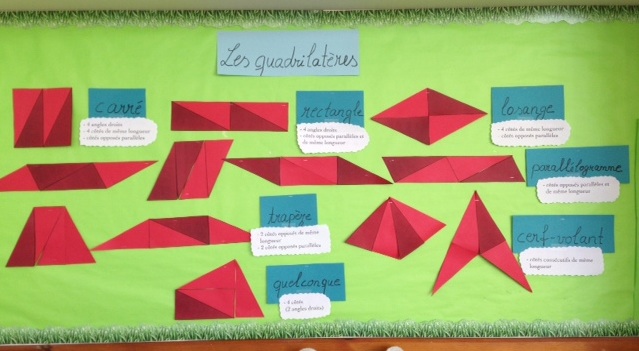
In 5th Grade Math Class, we are currently studying Quadrangles. In a first challenge, we had to assemble as many quadrangles as possible using 4 identical right-angled triangles. 

After finding all 12 different quadrangles, we classified them and learned about their specific properties. We are now creating a learning poster that contains all the different quadrangles (square, rectangle, lozenge, parallelogram, trapezoid).  
You can see the result in the classroom.