Saturday, March 19, 2011

Letter from an Irish Mother (- a bit of Irish wit!)

Tully Cross and Letterfrack, Co. Galway - photo: Willy LeBihan


Claddaghduff, Co. Galway - photo: Willy LeBihan


Dear Son,


Just a few lines to let you know I'm still alive. I'm writing this letter slowly because I know you can't read fast.


We are all doing very well. You won't recognize the house when you get home: we have moved. Your dad read in the newspaper that most accidents happen within 20 miles from your home, so we moved. I won't be able to send you the address because the last Irish family that lived here took the house numbers when they moved so that they wouldn't have to change their address.


Your father's got a really good job now. He's got 500 men under him. He's cutting the grass at the cemetery.


Your sister Mary had a baby this morning but I haven't found out if it's a boy or a girl so I don't know if you are an auntie or an uncle.


Your Uncle Patrick drowned last week in a vat of whiskey in the Dublin Brewery. Some workmates tried to save him but he fought them off bravely. They cremated him and it took three days to put out the fire.


I went to the doctor on Thursday and your father went with me. The doctor put a small tube in my mouth and told me not to talk for ten minutes. Your father offered to buy it from him.


The weather isn't bad here. It only rained twice this week, first for three days and then for four days.


We had a letter from the under-taker. He said if the last payment on your Grandmother's plot wasn't paid in seven days, up she comes!


John locked his keys in the car yesterday. We were really worried because it took him two hours to get me and your father out.


Your loving Mum


P.S. I was going to send you some money but I had already sealed the envelope.

Friday, March 18, 2011

Les 5 sens


This week in the preschool class, we have been learning about the 5 senses. The first sense we are working on now is ''l’ouie'' (hearing). In class, we have been listening to the sounds around us. We had to guess what we heard on a tape. We then had to discriminate between the sounds and attempt to follow stories based solely on sounds. Sometimes, it wasn't easy, but it was fun!

On St. Patrick's Day, we built some '' noise '' instruments filled with rice, corn or little rocks and we named them the maracas of Saint Patrick's. We practiced all together before bringing them home for the joy of our parents.

Les petits et les moyens

Au loup!


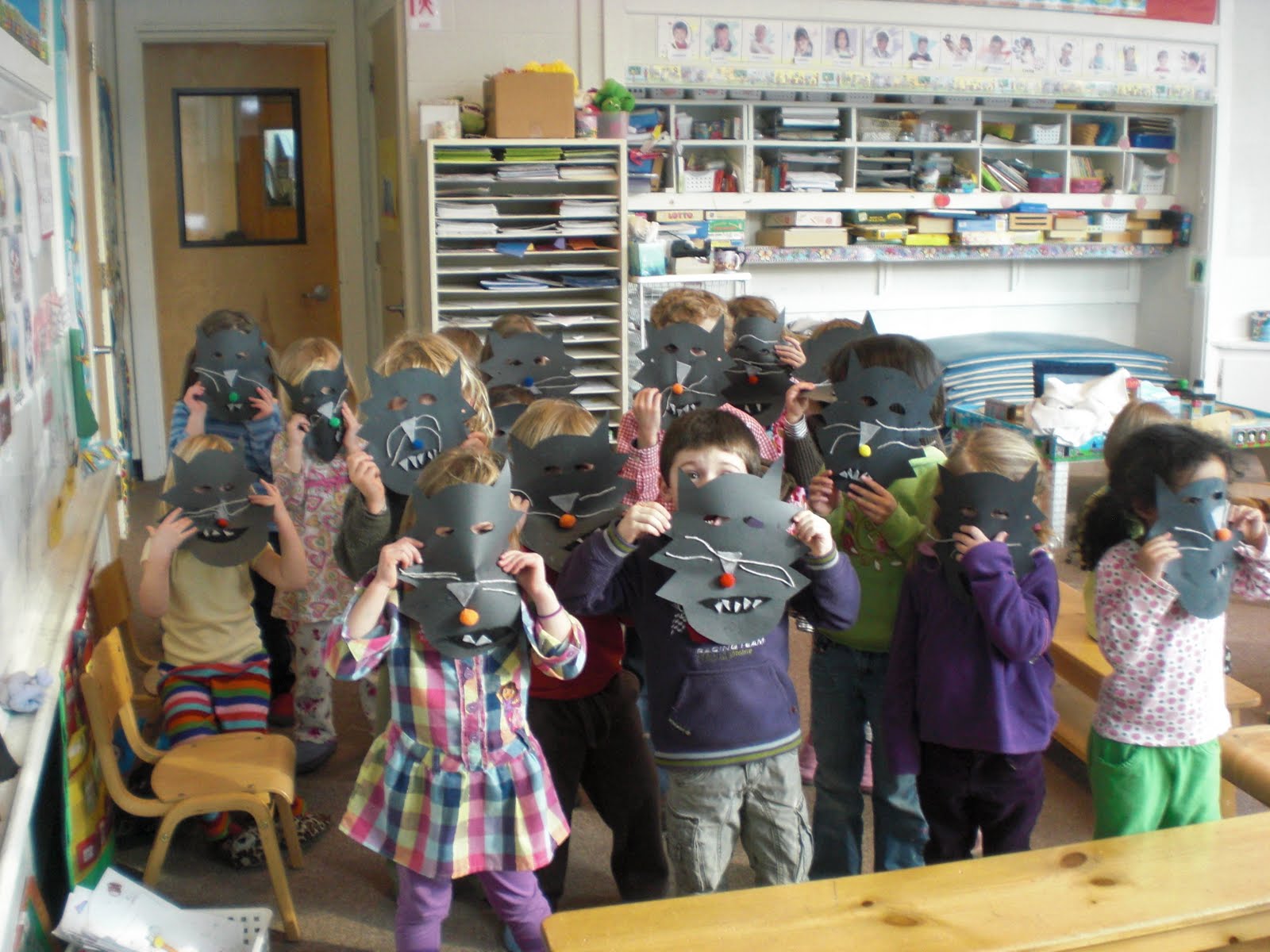
We have been talking and learning about the wolf in preschool class. During the last couple of weeks we learned about how and where the wolf lives. We listened to different stories featuring wolves and we also learned some new vocabulary. To finish, we made our own masks to transform ourselves into WOLVES.

Friday, February 18, 2011

Two languages make your brain buff

Elizabeth Landau - CNN.com - Health Writer/Producer - 02/18/11

If you had any doubts about exposing your child - or yourself - to a foreign language, there's more evidence than ever that being bilingual has enormous benefits for your brain.

Scientists presented their research supporting this idea Friday at the American Association for the Advancement of Science annual meeting in Washington, D.C.

As the human body begins its natural decline in old age, bilinguals seem to maintain better cognitive function, said Ellen Bialystok of York University in Toronto, Ontario. This is the case even for people with dementia. Bialystok and colleagues have studied many Alzheimer's patients, both monolinguals and bilinguals. They found that bilinguals were on average four to five years older than monolinguals at comparable points of neurological impairment.

Once Alzheimer's disease begins to compromise the brain, it appears that bilinguals can continue to function even though there’s damaged tissue, she said.

So what's going on? One theory is that language learning is an example of "cognitive reserve." It something that keeps the mind active in the same way as puzzles and games do, and works toward compensating for the build-up of dementia-causing pathology in the brain, Bialystok said.

In terms of starting language learning in middle or old age, the likelihood of becoming truly fluent in a new tongue is low, but it seems that every little bit helps in preventing cognitive decline, she said. And proficiency may be more important than age of acquisition, said Judith Kroll, researcher at Pennsylvania State University, before the conference.

Bilinguals are also better than monolinguals at multitasking, Kroll said. Juggling their languages helps bilinguals ignore irrelevant information and prioritize tasks better than those who only can only speak on tongue, she has found in her research. That makes sense considering that when a bilingual person speaks one language, the other language is still potentially active. That means that speakers of two languages are constantly inhibiting one language in favor of another, which perhaps enhances their overall attentional skills.

Why is it so hard for adults to learn a new language, compared with kids? The answer might not lie entirely in the brain. The social, educational, and other circumstantial conditions are different when an adult gets exposure to language, Bialystok said. As a child, learning a language is pretty much all you do. Adults can't devote as much time or attention to the experience of picking up a new tongue.

"It’s a change we can deal with as adults if there’s sufficient time and opportunity," she said.

Are there any downsides to being bilingual? Babies exposed to two languages throughout pregnancy, or who hear two languages in their first days of life, don’t confuse their languages, said Janet Weker of the University of California, Santa Barbara. The scientific evidence suggests bilingual and monolingual kids have similar language development milestones; it appears that children learning two languages do not experience delays in this regard generally.

There is, however, some research suggesting that the competition that’s produced by this mental juggling may introduce a delay in processing. But it’s so small that it’s not something that would be noticeable consciously, Kroll said. It appears that the benefits of being bilingual outweigh the costs.

Sugarloaf Outdoor Experience Program

On Friday, February 11, 2011, the elementary students went to Sugarloaf, USA for a day of alpine skiing. Beginning skiers participated in classes with Sugarloaf ski instructors while experienced skiers explored the mountain in small groups with teachers, parent volunteers and Sugarloaf Ambassadors. Students were treated to hot chocolate at Bullwinkle's secluded mountain restaurant. The whole day was a great success and much fun was had by all. One student, new to Maine, even saw two moose on the way home! Thanks to everyone who pitched in to make this outing possible!!


La Saint Valentin chez les petits


For Valentine's Day, the preschool children made special cards with Charlene's help. (She is a student teacher from France.)
They had lot of fun making a heart with salt dough. They painted it and decorated it. Then, they made the most beautiful drawing they could for their parents.
Merci Charlene!

Au menu cette semaine:

Snow Sculptures inspired by Goldsworthy


Grades 4, 5 & 6 in Art class with Valy

Wednesday, February 16, 2011

Welcome Charlène & Julie!


We would like to welcome Charlene and Julie who just arrived in Maine about a week ago.
They are both studying Education at the University of Dijon, France. During their second year of Master, their study is comprised of several four week internships, one of them at L'Ecole Française du Maine!
They are both living in host families from the school. During the week, they go into the classrooms and work with the children of grades 2-3-4 for Julie, and preschool for Charlene.
We will be welcoming two other students form Dijon in their first year of Master from April 25 to May 20. If you would like to be a host family, please contact us at info@efdm.org.

Happy Valentine's day!


Tuesday, February 15, 2011

Les GS/CP font du ski


The K-1 class went cross country skiing in Twin Brook last Friday. They had a lot of fun, and when they came back Emilia had prepared hot chocolate with marshmallows... Miam!

La chandeleur


Monday, February 14, 2011

Freeport Fields and Trails Project


Public Information Meeting
FREEPORT FIELDS and TRAILS PROJECT
A proposed field and trails project on Hunter Road
serving the greater Freeport community
that features multi-use athletic fields and trails and supports
more than 15 outdoor recreational activities --
It will benefit the kids of the future, the RSU athletic programs,
local merchants and businesses, and our entire community
*
Learn more about it Tuesday, February 15, 7 – 8:30pm Freeport Community Center, 53 Depot Street
*
Freeport Fields and Trails is a proposed community project that will bring extensive athletic fields, trails and recreation opportunities to residents of Freeport , young and old alike.
This unique plan combines 37 acres of new land to 260 acres of town owned land, including Hedgehog Mountain , Pownal Road Athletic Fields and the Seacoast United Athletic Field Development. The Freeport Field and Trails project will provide 4 new athletic fields suitable for soccer, field hockey, lacrosse or rugby, 3 new ball fields for little league baseball and softball, 10 – 20 kilometers of hiking/biking/Nordic trails once connected to the Hedgehog Mountain trail system, 1 sledding hill, and a recreational lodge. Freeport residents of all ages will have the outdoor recreational facility we have long desired.
Freeport Fields and Trails will also serve to alleviate some of the overcrowding, overuse and overlapping of our Middle School and High School fields while providing trails for the RSU’s cross country running and Nordic teams.
The Freeport Fields and Trails is a vital investment in our community. It will provide healthy alternatives for our children and their families while preserving open space. Additionally, it will have the added benefit of serving the customers and patrons of Freeport’s merchants, hotels and restaurants. The Fields and Trails will add to Freeport’s tourism base with athletic tournaments and events and the extensive trail systems will complete Freeport's reputation as an outdoor destination as well as a shopping destination.
CONTACT:
Sande Updegraph, Freeport Economic Development Corporation
865-4743, x 117, fedc@freeportmaine.com

Tuesday, February 8, 2011

Mon pays ce n’est pas un pays, c'est l'hiver


Mon pays ce n’est pas un pays, c'est l'hiver

These are the first few words of one of Quebec’s best-loved songs by chansonnier Gilles Vigneault. “My country is not a country, it’s the winter”- but it sounds much more poetic in French and for Quebeckers these words really evoke the sense of isolation created by Quebec’s fierce winter storms. They also evoke the different ways in which l’hiver has shaped our psyche – and in some circles l’hiver is even a metaphor for our sense of distinctiveness from the rest of Canada. So in Quebec, winter is more than a word – it’s a notion that’s at once seasonal and political!